Sparse Autoencoders
Sparse Autoencoders (SAEs) find interpretable features in a model's activations. Each feature is a "thing that the model knows", like "the Golden Gate Bridge" or "text in French". Here is an explainer on SAEs.
Neuronpedia hosts SAEs and similar methods from many research groups:
- SAEs - Standard, TopK, JumpReLU, and Matryoshka SAEs.
- Transcoders - Like SAEs, but they predict an MLP's output from its input. Transcoders and cross-layer transcoders (CLTs) are used in circuit tracing.
- Crosscoders - Features that are shared across layers or models.
Large releases include Gemma Scope and Gemma Scope 2 by Google DeepMind, Llama Scope, and SAEs for GPT-2, Pythia, Qwen, and more. See all of them under Releases in the top menu.
Example
The following is the source 20-gemmascope-res-16k for gemma-2-2b. It is one SAE: layer 20, residual stream, 16k features, from Gemma Scope. It is at neuronpedia.org/gemma-2-2b/20-gemmascope-res-16k.
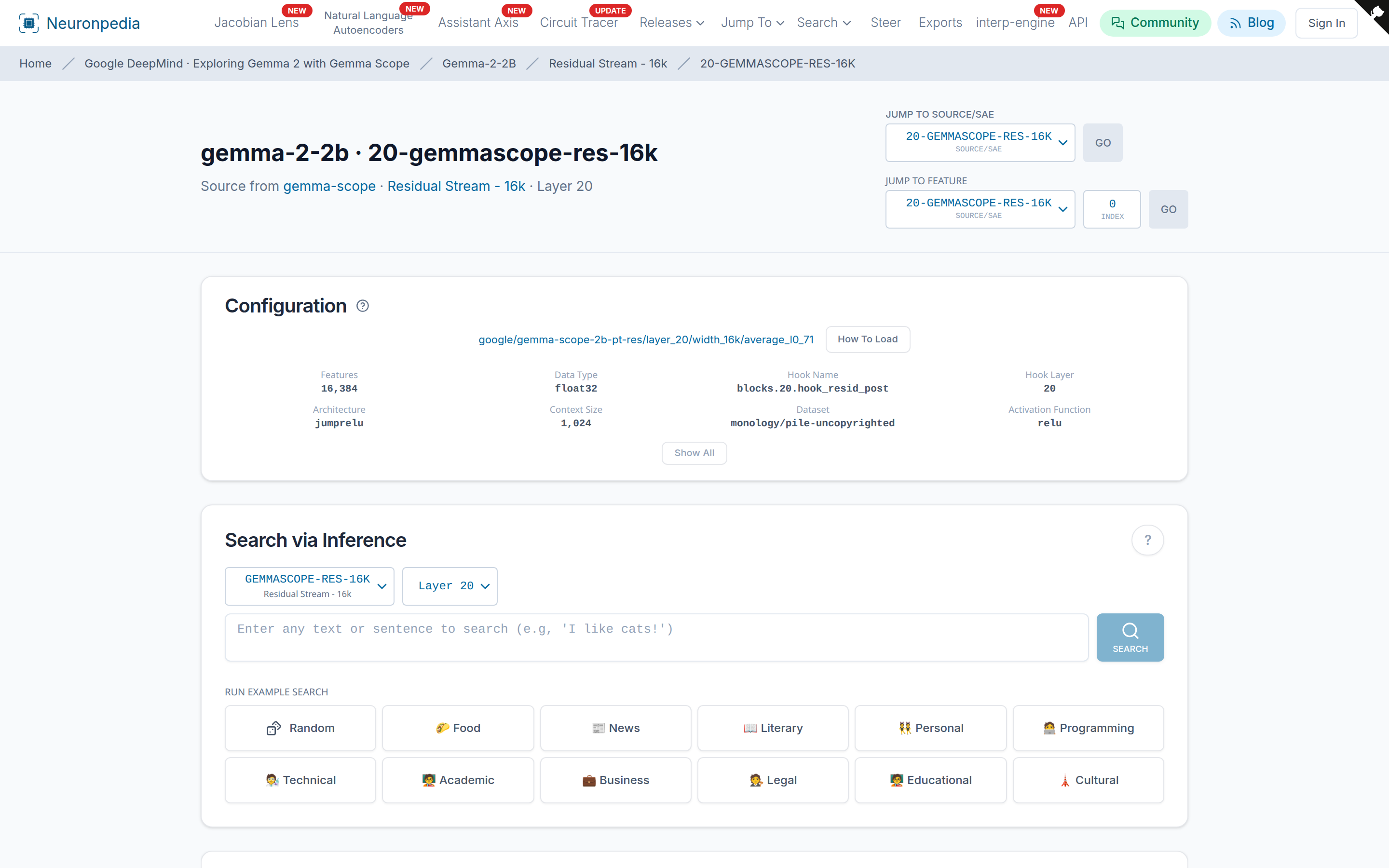
If you do not know the terms "source", "source set", or "release", read Key Concepts first.
What You Can Do
- Feature Dashboards - Look at a feature's top activations, logits, and explanations. Test it with your own text.
- Search - Find features by explanation text, or by running your own text through the model.
- Auto-Interp - Make and score explanations with AI models.
- Steering - Change the model's output with a feature.
- Lists - Save and share groups of features.
- Embeds - Show a feature on your website or blog.
- Upload Your SAEs - Add your own SAEs to Neuronpedia.