Key Concepts
Neuronpedia organizes data in a few levels. If you know these terms, the URLs and the API are easy to use.
Models
A model is the AI model that we study, for example gemma-2-2b or llama3.3-70b-it. Each model has a page at neuronpedia.org/[MODEL_ID].
Model IDs on Neuronpedia are not always the same as the HuggingFace IDs. For example, openai-community/gpt2 is gpt2-small on Neuronpedia.
Sources and Source Sets
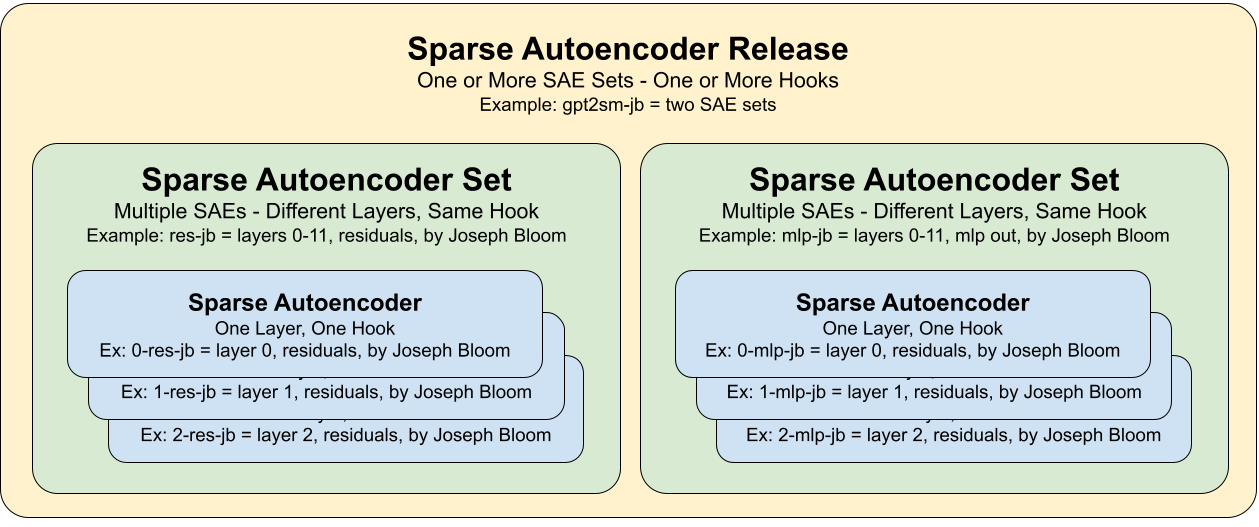
A source is a group of features (or neurons, or vectors) in one layer of a model. For example, one SAE is one source.
A source ID starts with the layer number, then the source set name:
20-gemmascope-res-16kis layer20of the source setgemmascope-res-16k.6-res-jbis layer6of the source setres-jb, which means "residual stream, by Joseph Bloom".
A source set is a group of sources that use the same method and hook, across many layers. For example, res-jb has 12 SAEs, one for each layer of GPT-2 Small.
Releases
A release is a group of one or more source sets. A release usually goes with a paper or a blog post. For example, Gemma Scope is a release with SAEs and transcoders for many layers and hooks of Gemma 2.
Features, Latents, Neurons, and Vectors
A feature is one direction in a source, and it has a number called an index. Some papers say latent instead of feature. On Neuronpedia, these are the same.
A feature has a unique ID with three parts: [MODEL_ID]/[SOURCE_ID]/[INDEX]. For example:
gemma-2-2b/20-gemmascope-res-16k/10956- Model:
gemma-2-2b - Source:
20-gemmascope-res-16k - Index:
10956
- Model:
Its URL is neuronpedia.org/gemma-2-2b/20-gemmascope-res-16k/10956.
Other things also use this format:
- Neurons - A model's own MLP neurons, for some older models.
- Transcoder features - Features from transcoders and cross-layer transcoders (CLTs). These are used in circuit tracing.
- Vectors - Custom steering vectors that users upload. See Steering.
- Attention heads - These use a different URL:
[MODEL_ID]/head/[LAYER]/[HEAD]. See Attention Heads.
Explanations
An explanation is a short text label for a feature, like "references to the Golden Gate Bridge". Most explanations are made by AI models. This is called auto-interp. See Auto-Interp.